

It Stole the Present
On fear, attention, and the quiet ways we leave our own lives

2:30 a.m.
My eyes open wide. Awake again.
A bead of sweat runs down my bald head and onto the pillow, and my legs feel as if they are vibrating beneath the sheets, as though some part of me is preparing to run, even though there is nowhere to go.
Something is on my mind. I know it because I was thinking about it while I was dreaming—something I just learned, or perhaps something I have known for a long time but have only now allowed myself to see clearly.
I am not afraid to die. I am afraid of not living.
I have had this dream before.
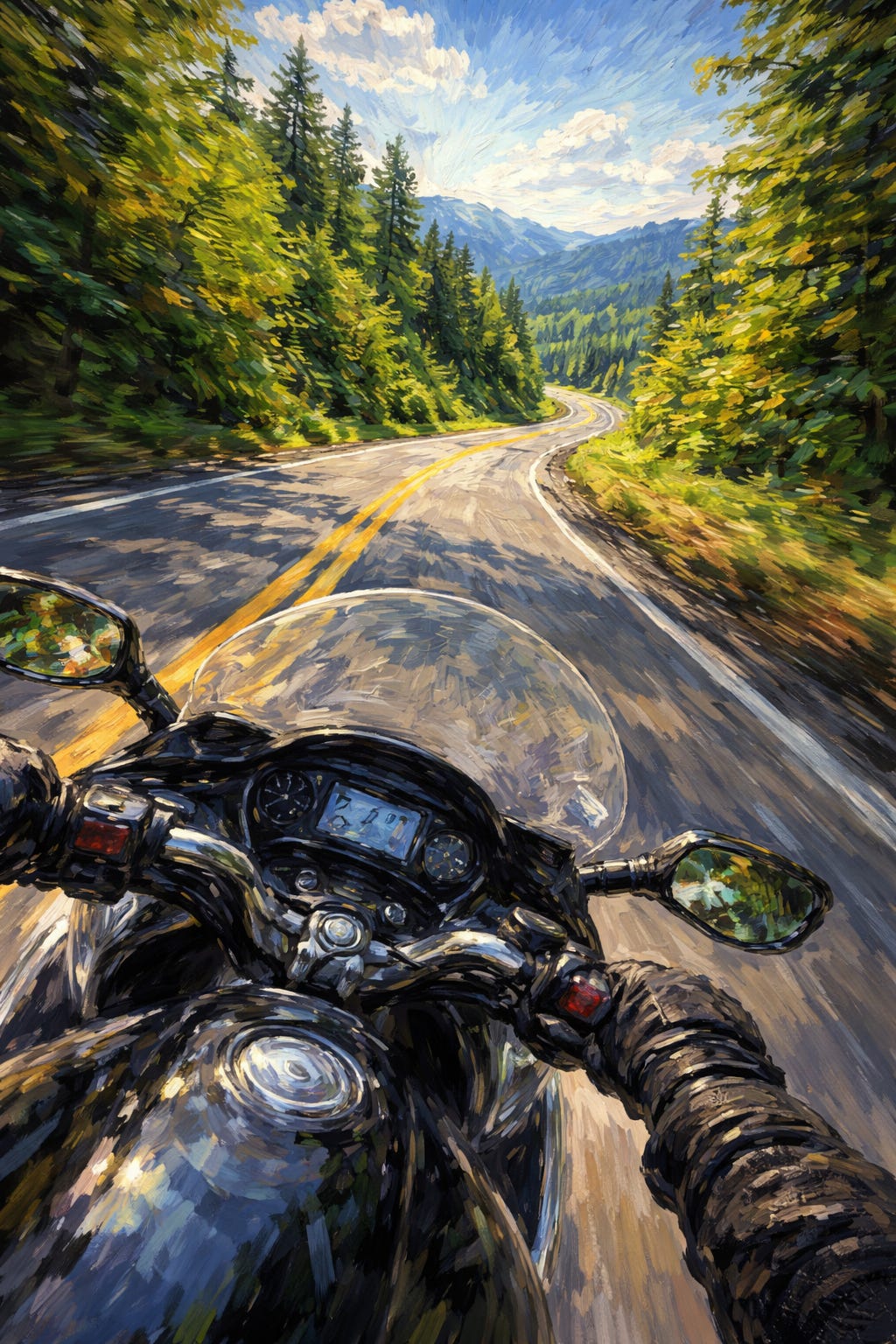
A car drifts into my lane as I take the long turn over the mountain pass on Route 136 in North Georgia. It is a long, curving U, the kind that invites you to lean just a little further than you should, and I lean the motorcycle over every single time. The motion is slow, almost languid, like making love to the pavement, the machine and the road and my body moving together in quiet agreement.
The young woman behind the wheel is texting, her eyes completely locked on her screen. She is coming into the curve too fast, and physics, indifferent as it always is, pulls her across the line and into my lane. There is always a moment when she feels it. She looks up, her eyes widening first with confusion, then recognition, and finally something that can only be described as terror. She sees me, low in the curve, coming into view faster than either of us would like, and her face contorts as if she is trying to outrun what is about to happen.
Then we make impact.
That is the instant I wake, shaking, flexing my fingers in the dark as if I need proof that I am still here, still among the living, still inhabiting this particular version of events.
I lie there longer than I care to admit before I remember to breathe—in, out, again—slowly, deliberately, as if I am reintroducing myself to something I should have never forgotten. Eventually the body settles, the mind loosens its grip, and I drift back into the quiet, sacred nothingness of sleep.
When I wake again, it is different. Softer. The last traces of sleep linger for a moment before letting go, and I can hear the birds outside already at work, raising cane in some bright, irrepressible chorus as they move from feeder to feeder. Light filters through the curtains, and beside me, still sleeping, is the love of my life, her form beneath the covers a quiet outline of beauty and familiarity.
It is another beautiful day, and even though I did not sleep well, I find myself grateful—truly grateful—and yet the thought remains, lingering just beneath the surface.
Yesterday I was riding my Suzuki Burgman 650 through that same mountain pass on my way to tutor my granddaughter, Savannah, in reading. One of the unexpected gifts of that time is that I also get to work with her sister, Kinsley. Reading matters. I believe that deeply. It takes a village, we say, but if I am being honest, I would do it all just for the hugs.
As I was riding, just as I entered that long, familiar curve, a thought appeared. It did not ask permission, did not announce itself; it simply arrived, fully formed—an image of an oncoming car drifting into my lane.
And just like that, one of my favorite moments—leaning into the mountain, feeling the road hold me, trusting the arc of the turn—was gone, replaced by something heavier, colder. The adrenaline that filled my body was no longer the kind that sharpens and awakens, but the kind that constricts and steals. It was the adrenaline of fear.
The imagined impact was immediate and absolute. There was no ambiguity in it. If it happened, I would die. And with that realization, the thought grew larger than it had any right to be, expanding until it filled the space and took something from me.
It stole the present.
By the time I came out of the curve, I had already begun, in some quiet and rational corner of my mind, to consider selling my cherished Burgman. The calculation had been made. The risk had been assessed. The joy had been replaced.
That is what fear does. Not always loudly or dramatically, but with a quiet efficiency that makes it easy to miss. It replaces the life you are living with one that has not happened, and more often than we would like to admit, we go along with it.
Then, just as quietly, another voice emerged—calm, familiar, unmistakably mine.
Calm down. Center. Breathe. Just breathe.
So I did.
For the next ten minutes I rode with intention, focusing on my breath, on the feel of the road rising through the machine and into my body, on the simple and undeniable fact that I was exactly where I was supposed to be. Gradually, almost without noticing when it happened, the grip loosened. The fear did not vanish so much as it was no longer fed.
And I was back—back in the ride, back in the moment, back in that quiet, unspoken agreement between man, machine, and road.
It was then that I could see it clearly: the thought, the reaction, and the choice between them. Because it was a choice. I could continue to inhabit the imagined future, or I could return to the only place life has ever actually occurred—the present moment.
So I chose again.
I chose the curve. I chose to trust the drivers in the opposite lane. I chose the sensation of the road moving beneath me at sixty miles per hour, the wind, the balance, the simple and profound act of being alive inside my own experience.
And as that choice settled into place, another thought surfaced—quieter still, but far more honest.
Even if you did die, would it be so bad to go out this way?
There was no bravado in it, no recklessness—only clarity. And in that clarity, something resolved.
I am not afraid to die. I am afraid of not living.
And this is not about motorcycles.
It is about the countless ways fear finds its way into our lives—at 2:30 in the morning, in a doctor’s office, in a bank account, in a conversation we avoid, in a risk we convince ourselves is not worth taking. It is subtle, efficient, and deeply convincing. It takes the moment we are in and replaces it with one that does not exist.
And we let it.
Because it feels safer. More responsible. More controlled.
But it is not living.
There is a balance we all attempt to strike between building a life and experiencing one. Material things can create opportunity, but it is only in stepping into that opportunity that life begins to take shape. Experience is not the reward for a well-managed life; it is the substance of it.
When I sit with that truth, so much of who I am begins to make sense. I am drawn to adventure. I am drawn to creating. And when the two intersect—when I find myself immersed in something that demands both presence and expression—I feel most like myself. The books I have written, the places I have gone, the moments I remember most clearly all share that same quality: I was there, fully there.
And perhaps that is the point. Not the extremes or the grand gestures, but the quiet, consistent act of returning to the present, again and again, even after it has been taken from us. Because it will be taken. That much is certain.
The question is whether we notice—and whether we choose to come back.
This is where life is lived. This is where meaning gathers. This is where the marrow is found and, if we are willing, fully consumed.
And this is why I am not afraid to die.
I am afraid of not living.
Because to not live would be to waste the greatest gift I have ever been given—the chance to be here at all.